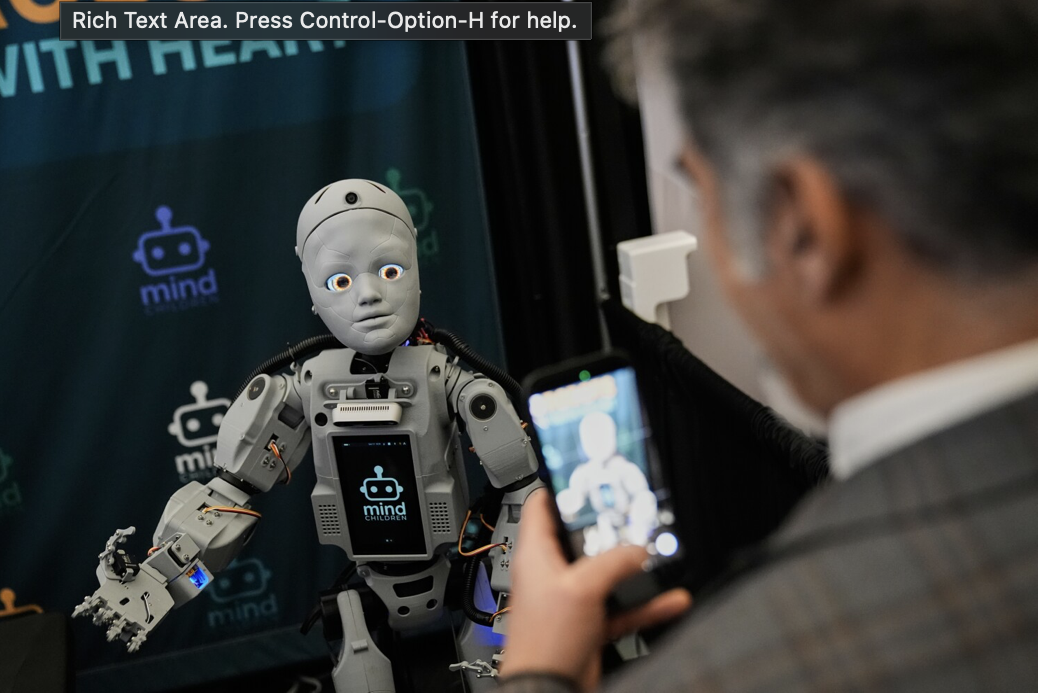


A new robot named Sprout is drawing attention in a Manhattan office—not because it looks powerful or futuristic, but because it looks friendly. Standing just 3.5 feet tall, Sprout has a rectangular head, blinking lights, windshield-wiper-like “eyebrows,” and padded sage-green foam that gives it a soft, approachable appearance. Designed by stealth startup Fauna Robotics, the humanoid is meant to feel less intimidating than the towering, industrial robots being developed by companies like Tesla and Boston Dynamics.
That approachability is intentional. A small child can comfortably stand face-to-face with Sprout, shake its gripper-like hands, and interact with it without fear. After two years of quiet research and development, Fauna unveiled Sprout publicly this week, hoping to spark a new market for robots designed for homes, schools, and social environments rather than factories.
Unlike most humanoid robots, which are expected to begin work in warehouses or manufacturing plants, Sprout is aimed at developers. Fauna envisions it as a platform similar to early personal computers—hardware that inspires others to build new applications. Priced at $50,000, Sprout is targeted at university labs, startups, and creative technologists. Early customers already include Disney and Boston Dynamics.
Sprout isn’t built for heavy labor. Instead, it can walk steadily, navigate rooms, pick up small objects, dance, and carry out simple tasks like checking a refrigerator. It uses cameras and mapping software to avoid obstacles and can recover its balance if it stumbles. Operators can control it with a game controller, smartphone app, or virtual-reality headset, or send it on preplanned missions.
Fauna’s founders believe recent advances in artificial intelligence, motors, and batteries finally make personal robots viable. Just as important, they argue, is rejecting the harsh, dystopian look common in robotics. Many existing humanoids are large, heavy, and potentially dangerous in close quarters.
Sprout draws inspiration instead from friendly science fiction robots like WALL-E, Baymax, and R2-D2. Fauna’s goal is to build a machine people actually want around. For CEO Rob Cochran, the most convincing validation comes from home: a video of his two-year-old twins jumping with excitement as Sprout greets them.